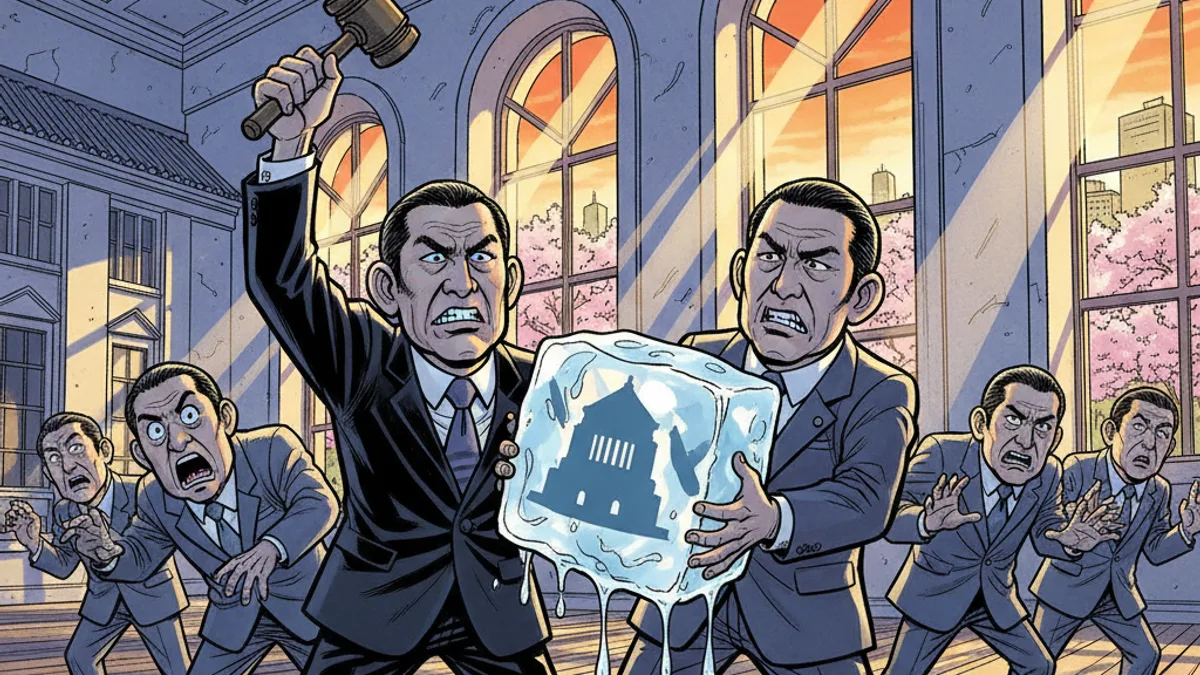
Diet Members' Bonus Freeze Bill Passes Lower House
Japan's House of Representatives approved freezing Diet members' bonuses until the next election. The bill now moves to the House of Councillors for final approval.
Key Points
- • Diet member bonus freeze approved by Lower House on May 26, 2026.
- • Freeze continues until next national election, timeline depends on election timing.
- • Bill now requires House of Councillors approval to become law.
- • Measure affects all 710 National Diet members' period-end allowance payments.
Japan's House of Representatives has approved legislation to freeze parliamentary bonuses until the next national election, a move that comes amid ongoing public scrutiny of lawmakers' compensation packages.
According to NHK, the revised Remuneration Act for Diet Members passed the lower house with majority support on May 26, 2026, and has now been sent to the House of Councillors for further deliberation. The legislation specifically targets the "period-end allowance" (kimatsu teate), which functions as a bonus payment for members of Japan's National Diet.
The bill ensures that these bonus payments will remain at current levels rather than receiving any increases that might otherwise occur through standard adjustments. This freeze will remain in effect until the next national election, though the specific timeline depends on when that election is called. In Japan's parliamentary system, House of Representatives elections must occur at least every four years, while House of Councillors elections happen every three years for half the upper house seats.
For foreign residents in Japan, this legislative development offers insight into the country's political accountability mechanisms and how lawmakers respond to public sentiment. While this decision directly affects only the 710 members of the National Diet—465 in the House of Representatives and 245 in the House of Councillors—it reflects broader discussions about public sector compensation that can influence policy decisions affecting all residents.
The freeze on parliamentary bonuses comes at a time when Japan continues to grapple with economic challenges, including inflation pressures that have affected household budgets across the country. By choosing to hold their own bonus payments steady, Diet members are demonstrating fiscal restraint that resonates with constituents who have experienced rising costs for food, energy, and other essentials.
This type of self-imposed limitation on lawmaker compensation is not unprecedented in Japan. The Diet has periodically adjusted or frozen its members' remuneration in response to economic conditions or following political controversies. Such measures serve as visible symbols of solidarity with the general public during difficult times.
For expats working in Japan or running businesses here, understanding these political dynamics can provide valuable context for interpreting government policy priorities. When lawmakers freeze their own compensation, it often signals a broader political environment focused on fiscal discipline, which may influence budget allocations, tax policies, and public spending decisions that affect everyone living in Japan.
The bill's passage through the House of Representatives represents just one step in Japan's legislative process. The House of Councillors must now review and vote on the measure. Given the majority support in the lower house, passage through the upper house appears likely, though the timing remains uncertain.
Japan's parliamentary system grants the House of Representatives precedence on most matters, meaning that even if the House of Councillors rejects or modifies the bill, the lower house can override that decision under certain circumstances. However, consensus between both chambers typically produces the smoothest path to enactment.
While this legislation may seem removed from the daily concerns of foreign residents, it exemplifies how Japan's political system balances public expectations with governance needs. The willingness of elected officials to limit their own financial benefits demonstrates accountability that contributes to political stability—a factor that makes Japan an attractive place for international professionals and businesses.
As the bill moves to the upper house, observers will watch whether it generates debate or passes smoothly. The outcome will offer further indication of the political consensus around parliamentary compensation and fiscal restraint heading into the next election cycle.