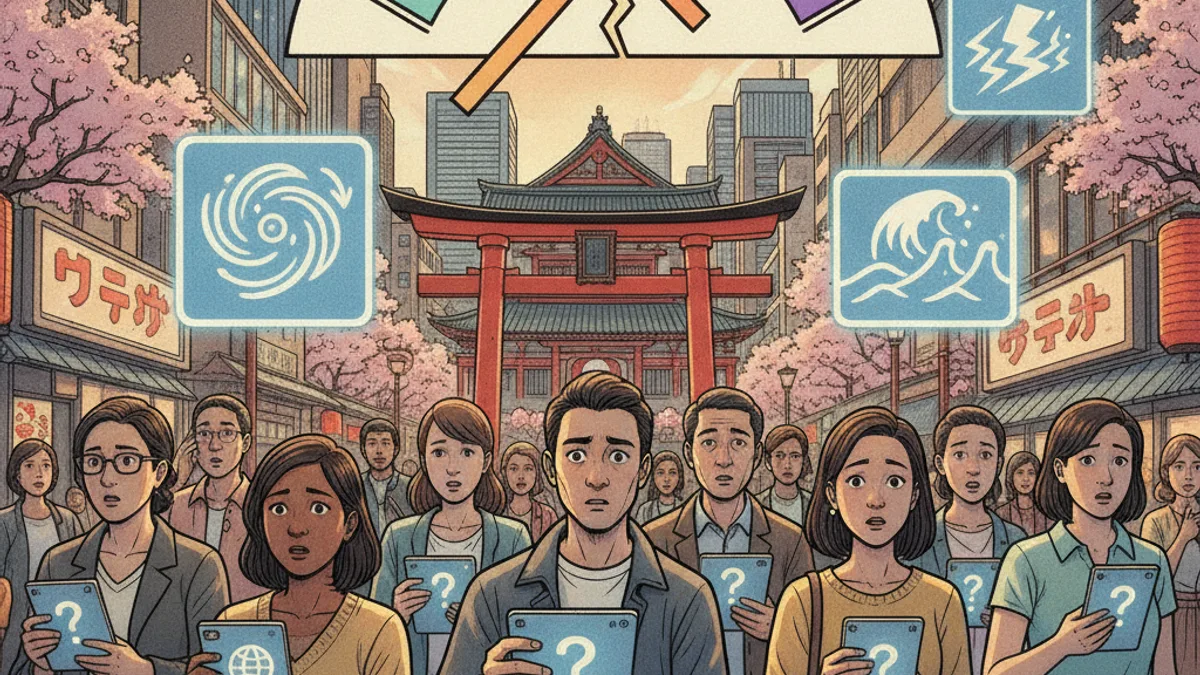
Most Residents Still Confused by Japan's Disaster Warning Levels, Survey Finds
A survey shows 60% of residents don't understand Japan's disaster warning levels eight years after reforms. Foreign residents face even greater risks due to language barriers during emergencies.
AI-written summary of Japanese reports; not human-reviewed; check the linked sources. How we write articles
Key Points
- • 60% of surveyed residents cannot explain Japan's five-level disaster warning system.
- • Level 4 warnings require immediate evacuation for all residents in affected areas.
- • Download Safety Tips app for multilingual emergency alerts and disaster information.
- • Register for your municipality's emergency notification system before disasters occur.
Eight years after the devastating Western Japan floods that claimed over 200 lives, approximately 60% of residents still don't understand Japan's disaster warning level system, according to a recent survey conducted by disaster preparedness experts in Hiroshima and two other prefectures, NHK reported on July 5, 2026.
The findings raise serious concerns for foreign residents who may face additional language and cultural barriers when interpreting emergency warnings during natural disasters.
The 2018 Western Japan floods, which primarily affected the Chugoku and Shikoku regions, prompted the Japanese government to overhaul its disaster information system by implementing a standardized five-level warning scale. The reform aimed to make emergency alerts clearer and more actionable for the public. However, the new survey reveals that this well-intentioned system remains poorly understood by a significant majority of the population.
The standardized warning system uses levels 1 through 5, with each level corresponding to specific recommended actions. Level 3 indicates elderly people and those with mobility issues should evacuate, Level 4 means all residents should evacuate, and Level 5 represents a disaster emergency when immediate life-saving actions are necessary. Despite the system being in place for several years, the survey conducted across Hiroshima and neighboring prefectures found that roughly six out of ten respondents couldn't accurately explain what the different levels meant.
For foreign residents living in Japan, this confusion among native Japanese speakers highlights a critical gap in disaster preparedness. Expats already face challenges understanding emergency alerts that typically arrive in Japanese through various channels including television broadcasts, municipal loudspeaker systems, and smartphone emergency notifications. If the majority of Japanese residents struggle to comprehend the warning levels, non-Japanese speakers face even greater risks during natural disasters.
The timing of this survey is particularly significant, coming just before the eighth anniversary of the Western Japan floods on July 6. That disaster resulted in massive casualties and property damage across western Japan, with Hiroshima Prefecture among the hardest hit areas. According to Yahoo Japan, over 80 cases of work-related disaster compensation have been recognized for public employees who responded to the 2018 floods, underscoring the scale and severity of that event.
Experts suggest that the confusion stems from several factors. The numerical levels may seem abstract without clear context about what actions residents should take. Additionally, the information is often delivered rapidly during emergencies, leaving little time for people to research or confirm what each level means. Language barriers compound these issues for foreign residents who may not have access to real-time translations of emergency broadcasts.
For expats living in Japan, particularly in regions prone to heavy rainfall and flooding, understanding the warning system is literally a matter of life and death. The rainy season, which typically runs from June through July, brings heightened flood risks to many parts of Japan. Foreign residents should take proactive steps to familiarize themselves with the five-level system before emergencies occur.
Practical recommendations include downloading multilingual disaster apps such as Safety Tips, which provides emergency alerts in multiple languages, and registering for your local municipality's emergency notification system. Many cities now offer email or app-based alerts in English and other languages. Additionally, expats should identify their designated evacuation centers and understand evacuation routes from their homes and workplaces.
The survey results suggest that Japanese authorities need to improve public education about the warning system. For foreign residents, the message is clear: don't wait for an emergency to learn what the warning levels mean. Taking time now to understand the system and prepare an evacuation plan could prove critical when the next major disaster strikes.
Sources
This article was written by AI from these Japanese-language reports. Check them before acting on anything here.
- [1] NHK — original report (Japanese)
- [2] Yahoo! Japan News — original report (Japanese)