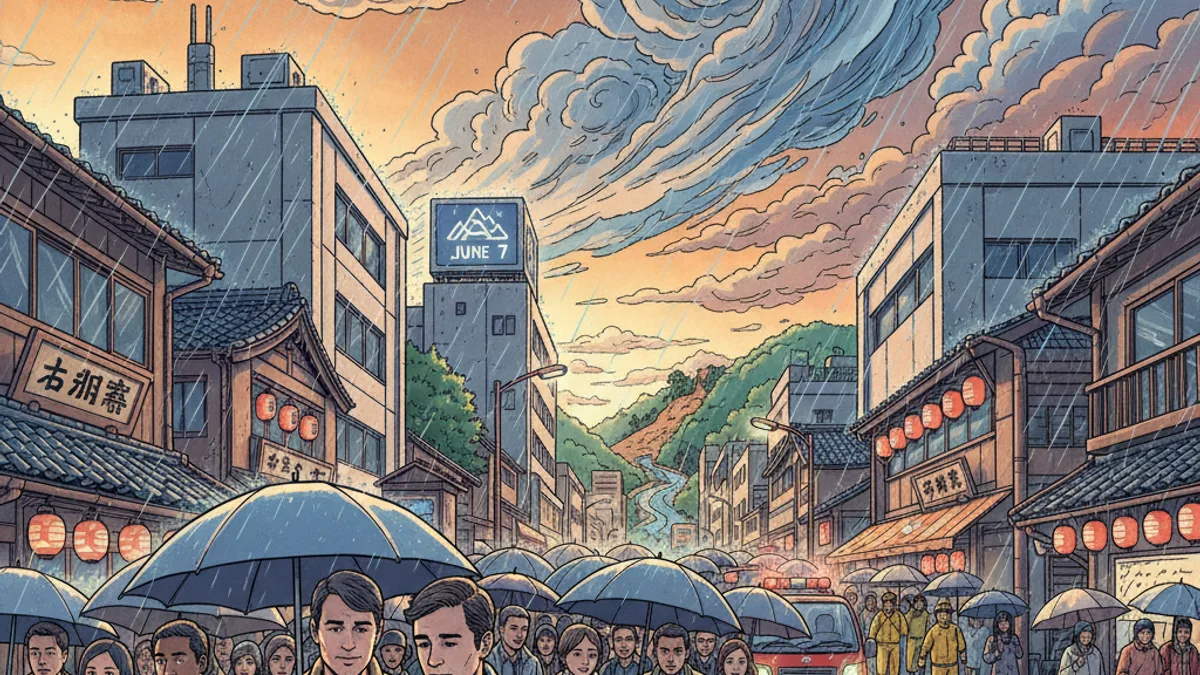
Severe Weather Alert: Linear Precipitation Band Risk in Southern Kyushu
Southern Kyushu faces severe weather with linear precipitation band risk on June 7th. Evacuation orders issued in Miyazaki affecting over 1,000 residents. Expats should monitor alerts and prepare for landslides and flooding.
AI-written summary of Japanese reports; not human-reviewed; check the linked sources. How we write articles
Key Points
- • Linear precipitation band likely June 7th morning through midday in southern Kyushu.
- • Kushima City issued evacuation orders affecting 712 households and 1,172 residents.
- • Kawaminami Town's Level 3 alert urges elderly and vulnerable residents to evacuate.
- • Check emergency supplies, charge devices, and locate nearest designated evacuation shelter.
Foreign residents in southern Kyushu should prepare for potentially dangerous weather conditions as Japan's Meteorological Agency warns of a linear precipitation band forming over the region on June 7th. This severe weather phenomenon, combined with ongoing heavy rainfall, has already prompted evacuation orders affecting over a thousand residents in Miyazaki Prefecture.
According to NHK, a low-pressure system moving along a weather front will pass through southern Kyushu on June 7th before continuing toward the southern coast of Honshu. The Meteorological Agency warns that a linear precipitation band—a type of organized storm system that can produce sustained torrential rainfall over the same area for hours—is likely to develop between the early morning hours and midday on June 7th.
Linear precipitation bands are particularly dangerous because they concentrate intense rainfall over a localized area for extended periods, dramatically increasing the risk of landslides, flooding, and rapid river level rises. The phenomenon has been responsible for some of Japan's most devastating flood disasters in recent years, making early preparation essential.
Miyazaki Prefecture faces the highest risk, with the Meteorological Agency specifically warning residents to exercise extreme caution regarding landslides and flooding. The unstable atmospheric conditions have already produced very heavy rainfall in parts of southern Kyushu, and conditions are expected to deteriorate further as the low-pressure system approaches.
Local authorities have begun issuing evacuation advisories and orders in response to the threat. In Kushima City, located in southern Miyazaki Prefecture, officials issued evacuation orders at 4:50 AM on June 7th for the Honjo district, affecting 712 households and 1,172 residents. According to NHK, the orders were issued due to heavy rainfall and rising water levels in the Honjo River, and authorities are urging residents in dangerous areas to evacuate immediately.
Kawaminami Town in Miyazaki Prefecture issued Level 3 evacuation information—classified as "evacuation for elderly and vulnerable persons"—at 5:00 PM on June 6th. This advisory affects 1,466 households and 2,968 people in certain areas of the town. Under Japan's five-level evacuation system, Level 3 means elderly residents, those with mobility issues, and families with small children should begin evacuating to designated shelters or safer locations.
For foreign residents unfamiliar with Japan's evacuation system, it's crucial to understand that Level 3 advisories indicate serious risk, while evacuation orders represent imminent danger requiring immediate action. Expats should monitor local government websites, download disaster alert apps, and register for emergency notifications in their municipality.
The heavy rainfall is expected to affect not only southern Kyushu but also the Pacific coast of western Japan more broadly. Residents across the region should prepare for potential transportation disruptions, including train delays or suspensions, and possible road closures due to flooding or landslide risks.
Expats living in affected areas should take several immediate precautions: secure outdoor items that could be blown away or cause damage, check emergency supply kits including flashlights and batteries, ensure mobile devices are fully charged, and identify the nearest designated evacuation shelter. Many municipal websites offer evacuation maps in multiple languages, and the Japan Meteorological Agency's website provides English-language weather warnings.
For those in mountainous areas or near rivers, the risk is particularly acute. Even if your immediate area isn't experiencing heavy rain, upstream rainfall can cause rapid river level increases. Never attempt to cross flooded roads or swollen streams, as water depth and current strength are difficult to judge and can be fatal.
As climate patterns continue to evolve, linear precipitation bands are becoming an increasingly recognized threat in Japan's disaster preparedness planning. Foreign residents should familiarize themselves with this terminology and understand that when such warnings are issued, the situation demands serious attention and prompt action to ensure personal safety.
Sources
This article was written by AI from these Japanese-language reports. Check them before acting on anything here.
- [1] NHK — original report (Japanese)
- [2] NHK — original report (Japanese)
- [3] Yahoo! Japan News — original report (Japanese)
- [4] NHK — original report (Japanese)
- [5] NHK — original report (Japanese)
- [6] NHK — original report (Japanese)