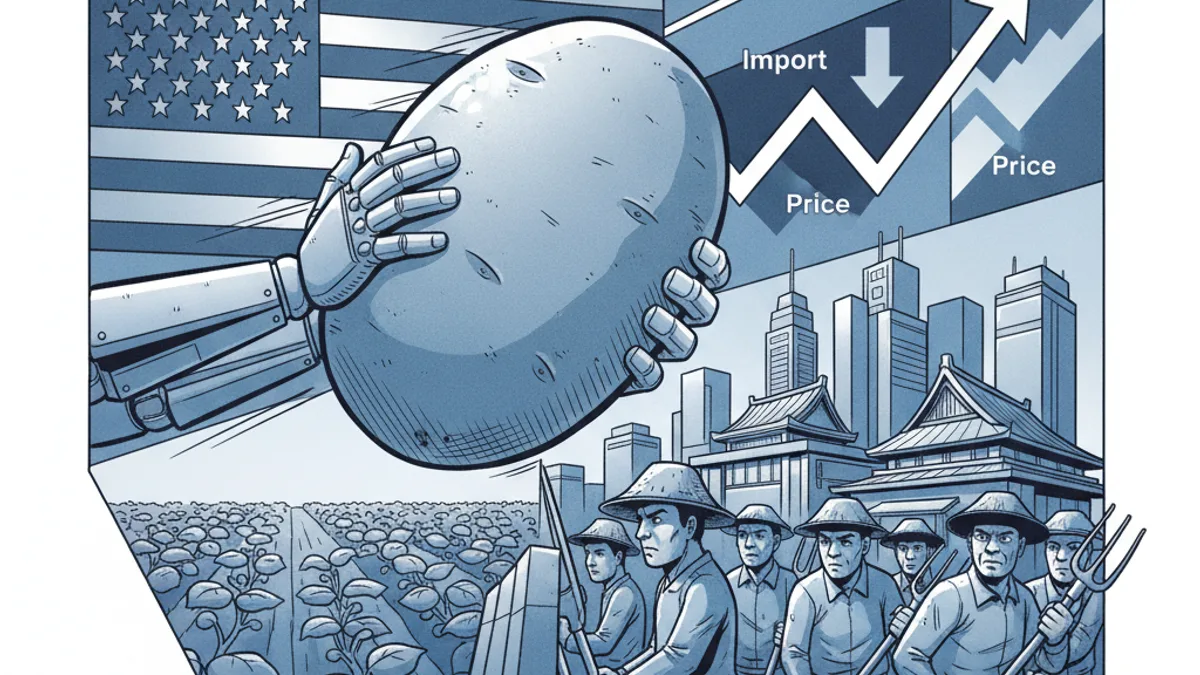
U.S. Potato Import Liberalization Sparks Opposition from Hokkaido Farmers
Japan's government is advancing plans to allow fresh U.S. potato imports, facing strong opposition from Hokkaido agricultural groups who fear market disruption and lower prices for domestic growers.
Key Points
- • Japanese government proceeding with procedures to liberalize fresh U.S. potato imports.
- • Hokkaido agricultural cooperatives strongly opposing the import liberalization plan.
- • Changes could eventually affect potato prices and variety in Japanese supermarkets.
- • Implementation likely delayed due to strong agricultural lobby political influence.
Japan's government is moving forward with procedures to liberalize imports of fresh potatoes from the United States, a decision that has sparked fierce opposition from Hokkaido's powerful agricultural lobby. The controversy highlights ongoing tensions between Japan's trade liberalization efforts and domestic agricultural protection, with potential implications for food prices and availability across the country.
According to NHK, the Japanese government has begun the formal process to lift restrictions on fresh potato imports from America. Currently, Japan only allows imports of processed potato products from the U.S., while fresh potatoes face strict import barriers primarily designed to protect domestic producers and prevent the introduction of foreign plant diseases.
The proposal has met with strong resistance from Japan's agricultural sector. On August 18, 2026, Isao Tarui, chairman of the JA Hokkaido Chuo-kai (Hokkaido Central Union of Agricultural Cooperatives), publicly stated that the organization "absolutely cannot accept" the import liberalization, according to NHK. The agricultural group has pledged to lobby the government to block the measure.
Hokkaido, Japan's northernmost main island, produces approximately 80 percent of the nation's potatoes, making the crop vital to the region's agricultural economy. Farmers and agricultural cooperatives fear that cheaper American imports could undercut domestic prices and threaten the livelihoods of thousands of potato growers across the prefecture.
The opposition centers on several key concerns. Japanese farmers worry that large-scale American potato operations, which benefit from economies of scale, could flood the market with lower-priced products. There are also phytosanitary concerns about introducing plant diseases or pests not currently present in Japan's tightly controlled agricultural environment.
For foreign residents in Japan, this policy debate could have practical implications for household budgets and food choices. Japan's potato prices are significantly higher than in many Western countries due to limited domestic production capacity and import restrictions. If liberalization proceeds despite agricultural opposition, consumers might eventually see greater variety and potentially lower prices for fresh potatoes in supermarkets.
However, any changes are unlikely to occur quickly. Japan's agricultural sector wields considerable political influence, particularly in rural areas that are overrepresented in the national legislature. The Liberal Democratic Party, which has governed Japan for most of the post-war period, has traditionally protected agricultural interests as part of its core constituency.
The potato import debate also reflects broader tensions in Japan's agricultural policy. The country faces pressure from trading partners, including the United States, to open its agricultural markets while simultaneously trying to maintain food security and protect domestic farmers. Japan's food self-sufficiency rate has declined to around 38 percent on a calorie basis, one of the lowest among developed nations, making agricultural policy a sensitive political issue.
For expats accustomed to agricultural markets in countries like the United States, Australia, or European nations, Japan's protective approach to farming may seem unusual. However, it reflects deep-seated concerns about food security, rural employment, and cultural values attached to domestic food production.
The outcome of this dispute remains uncertain. While the government has initiated liberalization procedures, strong opposition from Hokkaido's agricultural lobby could delay or modify the plans. Previous attempts to liberalize agricultural imports in Japan have often resulted in lengthy negotiations and compromises that partially satisfy both domestic producers and international trading partners.
Foreign residents should monitor this issue, as any eventual policy changes could affect the price and availability of potatoes and potato-based products in their local supermarkets. However, significant changes to Japan's potato market are unlikely to materialize in the immediate future given the strength of agricultural opposition.
Sources
This article was written by AI from these Japanese-language reports. Check them before acting on anything here.
- [1] Yahoo! Japan News — original report (Japanese)
- [2] NHK — original report (Japanese)
AI-written summary of Japanese reports; not human-reviewed; check the linked sources. How we write articles