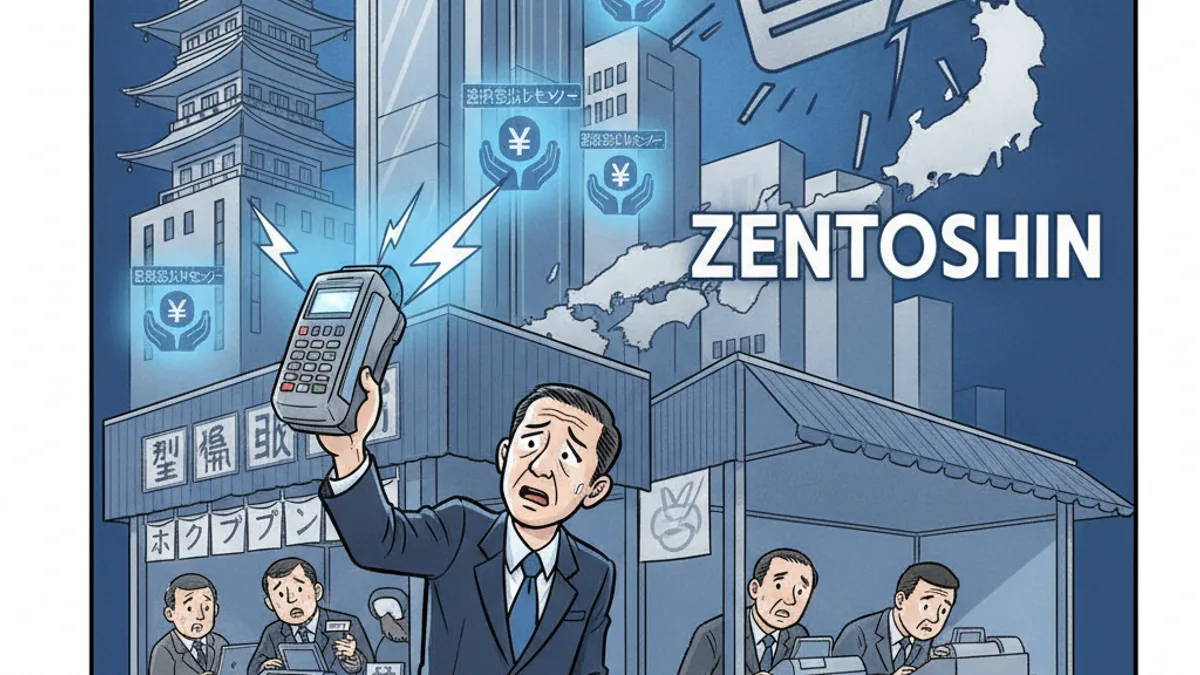
Credit Card Processor Zentoshin Bankruptcy Leaves Businesses Without Funds
Payment processor Zentoshin's bankruptcy leaves thousands of businesses unable to access sales revenue. Government establishes 378 consultation centers nationwide to assist affected merchants.
Key Points
- • Zentoshin bankruptcy prevents businesses from accessing recent credit card sales revenue.
- • Government opened 378 nationwide consultation centers starting July 10th for affected businesses.
- • Some businesses lost hundreds of thousands of yen in unreceived payments.
- • Company allegedly inflated finances and manipulated records before collapse.
Foreign business owners and residents in Japan face significant disruptions following the bankruptcy of Zentoshin Corporation (全東信), a major credit card payment processing company. The Tokyo District Court approved bankruptcy proceedings for the firm, leaving thousands of restaurants, retail shops, and service providers unable to access their recent sales revenue.
According to NHK, the Ministry of Economy, Trade and Industry responded swiftly to the crisis, with Economic Minister Akazawa announcing the establishment of 378 consultation centers nationwide starting July 10th. These centers are designed to assist affected business owners in understanding their options and accessing potential support measures.
The scale of the impact is substantial. Television personality Haruna Ai, who operates restaurants in Japan, revealed on Bunka Broadcasting radio that her three establishments collectively lost approximately 800,000 yen in unreceived payments from customer transactions processed through Zentoshin. This represents a significant cash flow disruption that many small business operators can ill afford.
Zentoshin attracted numerous small and medium-sized businesses primarily due to its competitive fee structure. The company offered lower processing fees compared to major competitors, making it particularly appealing to restaurants, beauty salons, and independent retailers operating on thin profit margins. However, this cost advantage has now resulted in severe financial consequences for businesses that depended on the service.
The bankruptcy's timing is particularly problematic for the hospitality sector. Many restaurants and cafes process the majority of their transactions through credit cards, especially in urban areas where cashless payments have become the norm. When a payment processor fails, merchants face a critical gap: they have already provided goods and services to customers whose credit cards were charged, but the funds never reached the business accounts.
According to NHK's investigative reporting, Zentoshin engaged in financial irregularities that contributed to its collapse. The company allegedly inflated its deposit balances and manipulated merchant transaction records to present a healthier financial picture than reality. These accounting manipulations were reportedly undertaken to maintain borrowing relationships with financial institutions, as the company had become heavily dependent on bank loans to sustain operations.
For foreign business owners in Japan, this situation highlights the importance of due diligence when selecting payment processing partners. While cost is certainly a factor, the stability and reputation of the service provider should be equally weighted in the decision-making process. Established processors with transparent financial backing may charge slightly higher fees, but offer greater security against such disruptions.
The government's response includes not only consultation services but also discussions about potential financial support mechanisms. According to Yahoo Japan Business reports, authorities are exploring ways to assist affected businesses with their immediate cash flow needs. However, the specifics of any aid packages have not yet been finalized.
Some businesses face existential threats from this disruption. Livedoor News reports that certain beauty salons are considering permanent closure due to the financial impact, unable to cover rent, employee salaries, and supplier payments without the expected revenue from recent transactions.
For expats operating businesses in Japan or considering entrepreneurship, several lessons emerge from this crisis. First, diversifying payment processing options can provide a safety net if one provider fails. Second, maintaining adequate cash reserves becomes even more critical when operating in a foreign business environment. Third, understanding the Japanese bankruptcy process and creditor rights is essential for anyone engaged in commerce.
Business owners affected by the Zentoshin bankruptcy should immediately contact the nearest consultation center established by METI to understand their rights as creditors in the bankruptcy proceedings and explore available support options. While full recovery of lost funds appears unlikely, government assistance programs may help bridge the immediate financial gap.
This incident serves as a stark reminder that in Japan's increasingly cashless economy, the reliability of payment infrastructure is not merely a convenience issue but a fundamental business survival concern.