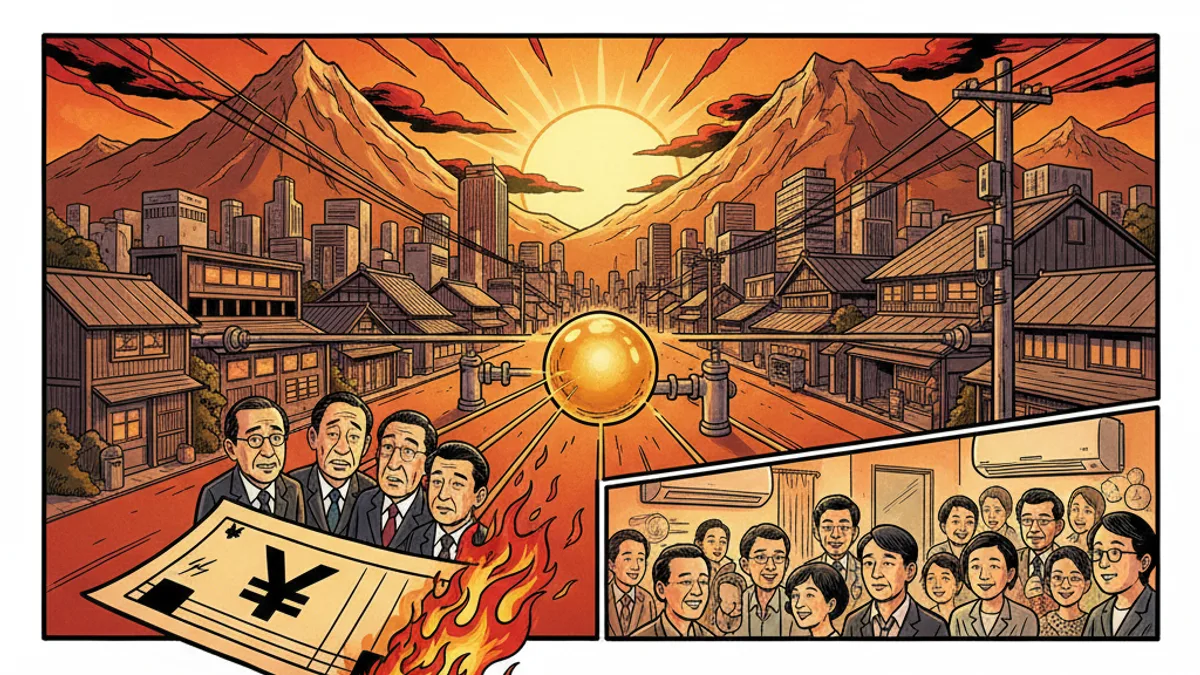
Japan Mulls Supplementary Budget for Energy Support as Middle East Tensions Rise
Japan's government is considering a supplementary budget to subsidize summer electricity and gas bills if Middle East tensions cause prolonged energy price increases, though fiscal concerns exist within government.
Key Points
- • Government may subsidize summer electricity and gas bills amid Middle East tensions.
- • Finance Minister instructed to examine supplementary budget compilation for current fiscal year.
- • Support would automatically reduce utility bills without requiring separate consumer applications.
- • Final decision depends on duration and severity of Middle East crisis.
The Japanese government is preparing contingency measures to shield households and businesses from potential energy price spikes stemming from escalating tensions in the Middle East, Prime Minister Takaichi announced on May 18, 2026. The response could include a supplementary budget and renewed subsidies for electricity and gas bills this summer.
According to NHK, Prime Minister Takaichi revealed during a government-ruling party liaison meeting that she has instructed Finance Minister Katayama and other cabinet members to examine funding arrangements, including the compilation of a supplementary budget for the current fiscal year, should the Middle East situation prove prolonged. The directive signals the government's readiness to act swiftly if energy market disruptions threaten Japan's economic recovery and household finances.
The proposed measures center on potential support for electricity and gas rates during the summer months, when energy consumption typically peaks due to air conditioning demand. Government and ruling party officials are coordinating on the specifics of support policies and their scale, with decisions dependent on how the Middle East crisis unfolds and its impact on global energy markets.
For foreign residents in Japan, these developments carry significant practical implications. Energy costs represent a substantial portion of household expenses, particularly during summer and winter when climate control is essential. Any government subsidy program would likely reduce monthly utility bills, providing relief similar to previous support measures implemented during earlier energy crises.
Japan remains heavily dependent on imported energy, with the Middle East supplying a significant portion of the nation's crude oil and natural gas. Disruptions to supply chains or price volatility in the region directly affect Japanese energy costs, making the government's proactive stance particularly relevant for budget-conscious households.
However, the proposal has sparked concerns within government circles about fiscal sustainability. Yahoo Japan reports that some officials worry about the budgetary implications of additional spending, given Japan's already substantial public debt. The government must balance immediate relief for consumers against longer-term fiscal discipline, a tension that could influence the final scope and duration of any support package.
Previous energy support programs in Japan typically operated through subsidies paid directly to utility companies, which then reflected the assistance in reduced bills for consumers. If the government proceeds with similar measures this time, foreign residents would automatically benefit through lower monthly charges without needing to apply for assistance separately. The subsidies would appear as line-item deductions on utility statements.
The timing of any support measures remains uncertain and contingent on Middle East developments. The government's approach appears deliberately flexible, allowing officials to scale their response according to actual market conditions rather than committing to fixed programs immediately. This wait-and-see strategy aims to avoid unnecessary spending while maintaining readiness to act if conditions deteriorate.
For expats managing household budgets, the announcement suggests several considerations. First, energy prices may increase in coming months if Middle East tensions escalate, making energy conservation efforts more valuable. Second, government intervention could moderate these increases, though the extent and timing remain unclear. Third, monitoring official announcements through English-language news sources will be important for understanding when and how any support measures take effect.
The ruling coalition, comprising the Liberal Democratic Party and Komeito, appears aligned on the need for preparedness, though specific policy details require further negotiation. The involvement of multiple ministries in planning suggests a comprehensive approach addressing not only household energy costs but potentially broader economic impacts.
As the situation develops, foreign residents should stay informed through official government channels and major news outlets. While immediate action is not required, understanding the potential for both energy price increases and government support will help expats plan their household finances effectively in the months ahead. The government's commitment to examining supplementary budget options demonstrates its recognition that energy security and affordability remain critical issues for all residents of Japan.