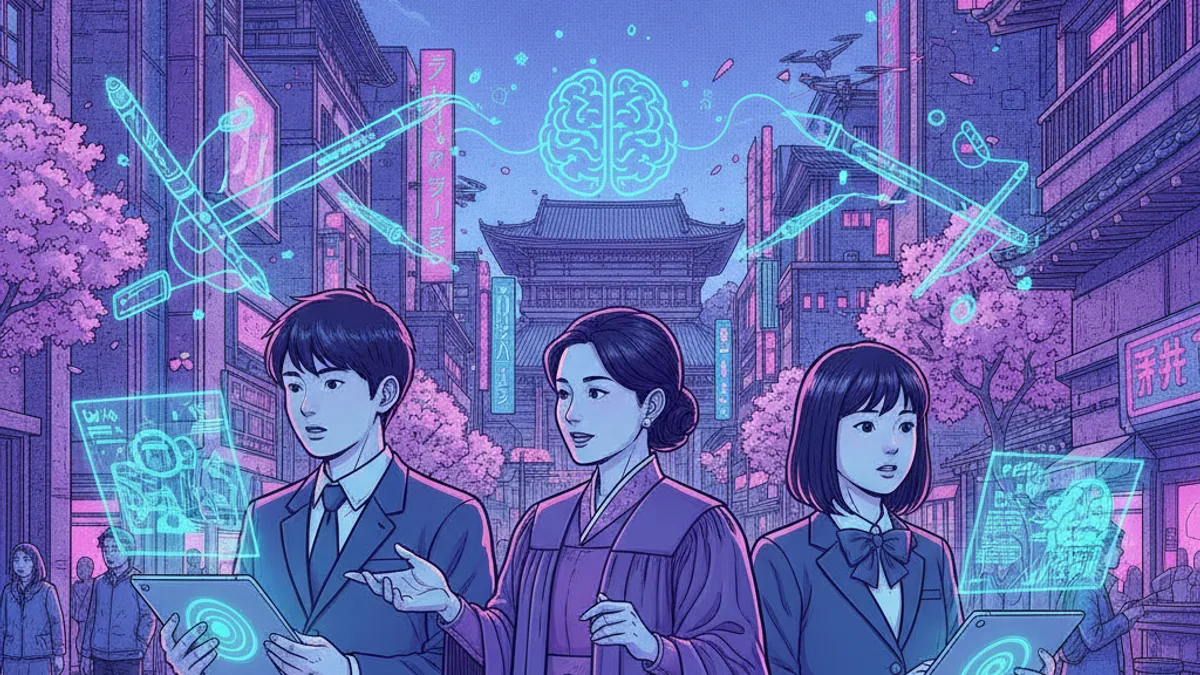
Japan's Schools Adapt Assessment Methods as Student AI Usage Doubles
Student AI usage has doubled since 2024, prompting Japanese schools to require oral explanations alongside written work. MEXT's new guidelines aim to verify genuine understanding while allowing AI as a learning tool.
AI-written summary of Japanese reports; not human-reviewed; check the linked sources. How we write articles
Key Points
- • Student generative AI usage doubled since 2024 academic year in Japan.
- • Schools now require oral explanations when evaluating essays and compositions.
- • Teachers implementing multifaceted assessments to verify genuine student understanding.
- • Over half of Japanese individuals have used AI, below China and US rates.
Foreign families living in Japan should prepare for significant changes in how schools evaluate student work as generative AI adoption among young people has surged dramatically over the past year, prompting education authorities to overhaul traditional assessment methods.
According to Yahoo Japan, the number of students with experience using generative AI tools has doubled since the 2024 academic year, reflecting a broader trend of AI integration into daily learning activities. This rapid adoption has prompted Japan's Ministry of Education, Culture, Sports, Science and Technology (MEXT) to develop new guidelines for evaluating student assignments in an era where AI-generated content is readily accessible.
The most significant change affects how Japanese language composition assignments will be assessed. According to NHK, a MEXT advisory council has proposed that teachers should no longer rely solely on written submissions when grading essays and compositions. Instead, educators are being encouraged to implement multifaceted evaluation methods that include requiring students to provide oral explanations of their work. This approach aims to verify genuine understanding and prevent over-reliance on AI-generated content while still allowing students to benefit from AI as a learning tool.
For expat families with children in Japanese schools, these changes mean students may increasingly be asked to explain their thought processes verbally, discuss their research methods, or defend their written arguments in classroom settings. Parents should encourage children to develop both writing and speaking skills, as the ability to articulate ideas orally will become a more prominent component of academic evaluation.
The education sector's response comes as Japan's overall AI adoption continues to grow, though at a slower pace than some other developed nations. Total usage figures from the Ministry of Internal Affairs and Communications, as reported by NHK, show that for the first time, more than half of Japanese individuals have now used generative AI services. However, this adoption rate remains lower than countries like China and the United States for both individual and corporate usage.
Education experts view the new assessment guidelines as a pragmatic approach that acknowledges AI's permanent presence in students' lives while maintaining academic integrity. Rather than attempting to ban AI tools outright—a strategy many educators consider futile—Japanese schools are adapting their evaluation methods to distinguish between students who use AI as a learning aid and those who may be submitting AI-generated work without genuine comprehension.
For international school students and those in Japanese public schools, the practical implications are clear. Students should be prepared to discuss their assignments in detail, explain their reasoning, and demonstrate understanding beyond what appears on paper. Teachers may implement various verification methods, including in-class discussions, presentations, or follow-up questions about submitted work.
Parents of school-age children should communicate with teachers about specific assessment policies at their child's school, as implementation may vary between institutions. Some schools may adopt these guidelines more quickly than others, and international schools may develop their own approaches based on MEXT's framework while considering their diverse student populations.
The shift also presents opportunities for students to develop valuable skills. The ability to explain complex ideas clearly, think critically about information sources, and engage in substantive discussions are competencies that will serve students well beyond their school years, particularly in Japan's evolving professional landscape where AI literacy is increasingly valued.
As Japan's education system continues adapting to technological change, expat families should view these developments as part of a broader commitment to maintaining educational quality while embracing innovation. The focus on oral communication and comprehensive understanding aligns with skills that international employers increasingly prioritize, potentially benefiting students in their future academic and professional pursuits.
Sources
This article was written by AI from these Japanese-language reports. Check them before acting on anything here.
- [1] Yahoo! Japan News — original report (Japanese)
- [2] NHK — original report (Japanese)
- [3] NHK — original report (Japanese)