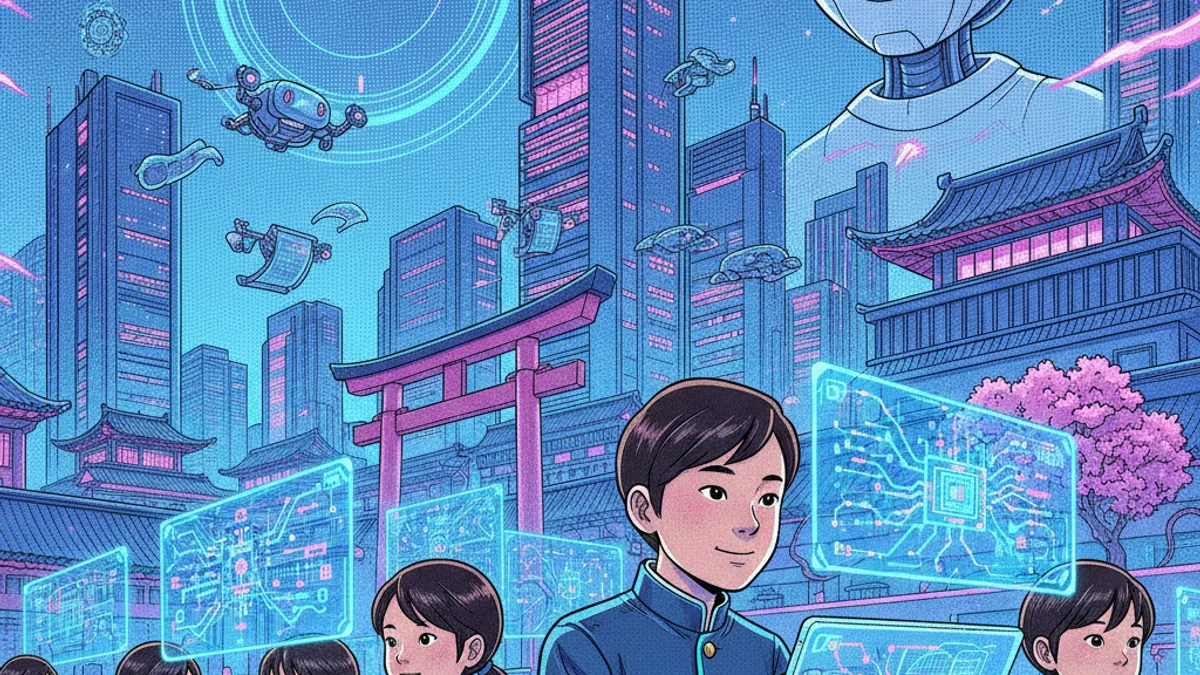
Japan Schools to Integrate AI Education, Gain Flexibility in Class Hours
Japan will introduce AI education across all subjects and grant schools flexibility in class scheduling starting in four years, affecting all public school students including expat children.
Key Points
- • New curriculum integrating generative AI education launches in four years nationwide.
- • Junior high schools will offer new "Information and Technology" subject.
- • Schools can now adjust class hours per subject independently.
- • AI content will appear across all subjects, not just technology classes.
Japan's Ministry of Education (MEXT) has announced sweeping changes to the national school curriculum that will take effect in four years, introducing artificial intelligence education across all grade levels and giving schools unprecedented flexibility in managing class hours. These reforms, announced on August 31, 2026, represent the most significant shift in Japanese education policy in recent years and will affect all students in the public school system, including children of foreign residents.
According to NHK, the new curriculum guidelines will incorporate generative AI education for the first time, marking a fundamental shift in how Japanese schools approach technology and information literacy. The changes will apply to both elementary and junior high schools, with AI-related content being integrated across all subjects rather than confined to a single technology class.
For junior high schools, MEXT's advisory council has proposed creating a new subject called "Information and Technology" (情報・技術科), which will significantly expand upon the current technology curriculum. This new subject will place substantial emphasis on understanding and utilizing generative AI tools, preparing students for a rapidly evolving digital workplace. The curriculum will cover not only the practical applications of AI but also critical thinking about its ethical implications and limitations.
What makes this reform particularly noteworthy is the inclusion of AI-related content across all subjects, not just technology classes. According to Yahoo Japan's reporting, AI references will appear throughout the curriculum guidelines, suggesting that students will learn to use these tools in contexts ranging from language learning to mathematics and science. This cross-curricular approach aims to normalize AI as an educational tool rather than treating it as a specialized topic.
Perhaps equally significant for schools and families is the new flexibility in class hour allocation. MEXT's advisory council has approved a system allowing elementary and junior high schools to adjust the number of class hours for different subjects based on their own judgment. This represents a departure from the traditionally rigid structure of Japanese education, where class hours were strictly prescribed at the national level.
Under the new system, schools will have the autonomy to increase or decrease teaching time for specific subjects according to their students' needs and the school's educational priorities. This flexibility could allow international schools and schools with significant foreign student populations to better accommodate diverse learning needs, though the extent of this flexibility and its specific parameters have not yet been fully detailed.
For expat families with children in Japanese public schools, these changes signal a more technology-forward educational environment. Parents should be aware that their children will be expected to engage with AI tools as part of their regular coursework, which may require additional digital literacy support at home, particularly for families less familiar with these technologies.
The reforms also suggest that individual schools may develop increasingly distinct educational approaches as they exercise their new scheduling flexibility. Parents may want to inquire about how their children's specific schools plan to implement these changes and whether additional resources or support will be provided for students who may need extra assistance with technology-based learning.
The implementation timeline of four years gives schools, teachers, and families time to prepare for these significant changes. However, expat families should monitor announcements from their local boards of education for more specific details about how these national guidelines will be implemented at the municipal and school levels.
These curriculum reforms reflect Japan's broader push to maintain competitiveness in an increasingly digital global economy while addressing concerns about students' preparedness for future careers. For foreign residents, understanding these changes will be crucial for supporting their children's education and ensuring they can fully participate in Japan's evolving educational landscape.
Sources
This article was written by AI from these Japanese-language reports. Check them before acting on anything here.
- [1] NHK — original report (Japanese)
- [2] NHK — original report (Japanese)
- [3] Yahoo! Japan News — original report (Japanese)
AI-written summary of Japanese reports; not human-reviewed; check the linked sources. How we write articles