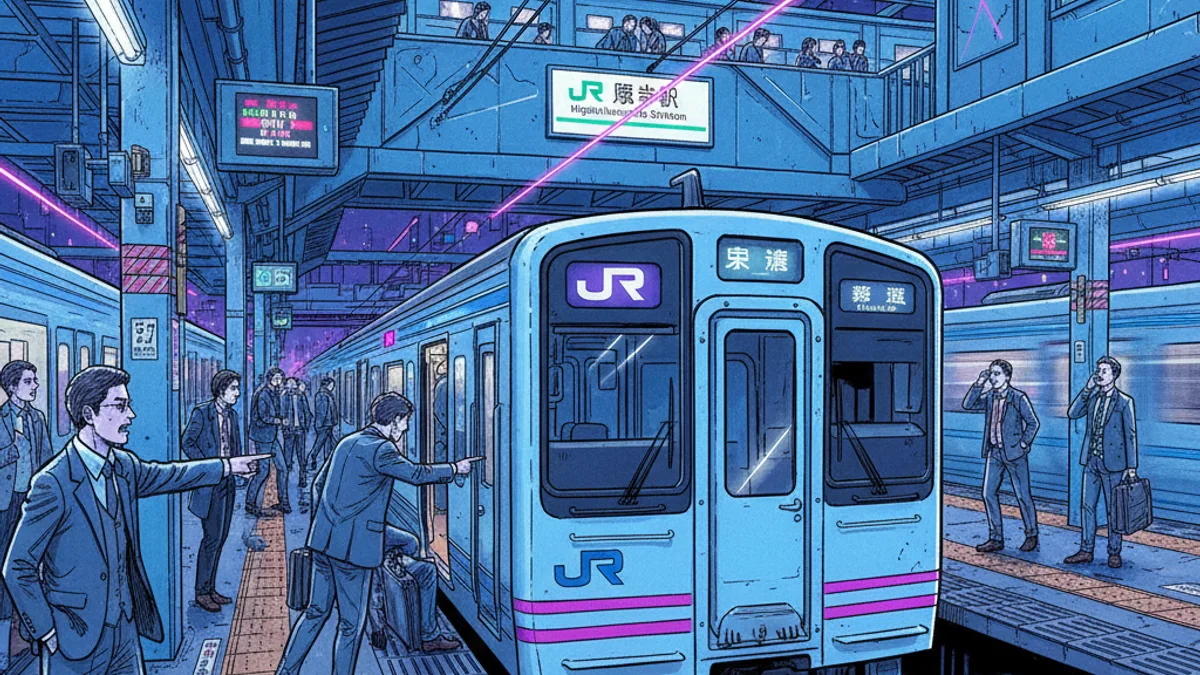
JR Yokohama Line Disrupted as Train Doors Fail at Higashi-Kanagawa Station
A JR Yokohama Line train experienced door failures at Higashi-Kanagawa Station on April 19, forcing passengers to transfer at Yokohama Station and causing service delays on this major commuter route.
Key Points
- • Train doors failed to open at Higashi-Kanagawa Station on April 19, 2026.
- • Passengers transferred at Yokohama Station to continue their journeys on alternative services.
- • Download JR East apps for real-time English delay notifications and updates.
- • Request delay certificates at station gates for employer or school documentation.
Commuters on the JR Yokohama Line faced significant delays on April 19, 2026, when a train's doors failed to open at Higashi-Kanagawa Station, preventing passengers from boarding or alighting. The incident, widely reported by Japanese media outlets including Yahoo Japan Business and Livedoor News, highlights ongoing challenges with railway infrastructure reliability that foreign residents who depend on Japan's train network should be aware of.
According to reports from Yahoo Japan Business, the door malfunction occurred during regular service hours, leaving passengers stranded inside the train while would-be riders on the platform were unable to board. The technical failure affected normal operations on one of Yokohama's busiest commuter lines, which connects Yokohama Station with Hachioji in western Tokyo, serving numerous residential and commercial areas.
JR East, the railway operator responsible for the Yokohama Line, was forced to implement alternative arrangements for affected passengers. As reported by Livedoor News, passengers already aboard the malfunctioning train were directed to disembark at Yokohama Station, the next major stop on the line, where they could transfer to other services or wait for subsequent trains. This solution, while practical, added considerable time to many commuters' journeys during what appeared to be a busy travel period.
For foreign residents living along the Yokohama Line corridor, this incident serves as a reminder of the importance of building buffer time into travel schedules, particularly for critical appointments or flight connections. While Japan's railway system is renowned worldwide for its punctuality and reliability, mechanical failures do occasionally occur, and understanding how to navigate disruptions is essential for anyone relying on public transportation.
The Yokohama Line is a crucial artery for commuters in the greater Yokohama and western Tokyo areas, carrying thousands of passengers daily between major hubs. The line serves key stations including Shin-Yokohama, home to the Shinkansen station, making it particularly important for both domestic and international travelers. Any disruption on this line can have cascading effects on connecting services and commuter schedules.
While the exact cause of the door malfunction has not been publicly disclosed in available reports, such incidents typically result from electrical failures, sensor malfunctions, or mechanical issues with the door operating systems. JR East maintains rigorous safety protocols, and trains experiencing door problems are generally taken out of service quickly to prevent safety hazards and minimize disruption.
For expats navigating such situations, several practical steps can help minimize inconvenience. First, download official railway apps such as JR East's app or third-party services like Hyperdia, which provide real-time updates on delays and service disruptions in English. Second, familiarize yourself with alternative routes between your common destinations, as Tokyo's dense rail network often offers multiple options. Third, consider keeping the customer service numbers for your regular train lines saved in your phone, though be aware that English support may be limited.
Passengers affected by train delays in Japan may be eligible for delay certificates (chien shoumeisho), which are typically distributed at station gates or available through railway apps. These certificates are widely accepted by employers and schools as proof of transportation issues, an important cultural practice that foreign residents should understand and utilize when needed.
While this particular incident was resolved relatively quickly through passenger transfers at Yokohama Station, it underscores the reality that even Japan's highly efficient railway system is not immune to technical problems. For the foreign community living in Japan, staying informed about service disruptions, maintaining flexibility in travel plans, and understanding local protocols for handling delays are essential skills for daily life in this train-dependent society.
Sources
This article was written by AI from these Japanese-language reports. Check them before acting on anything here.
- [1] Yahoo! Japan News — original report (Japanese)
- [2] Livedoor News — original report (Japanese)
AI-written summary of Japanese reports; not human-reviewed; check the linked sources. How we write articles