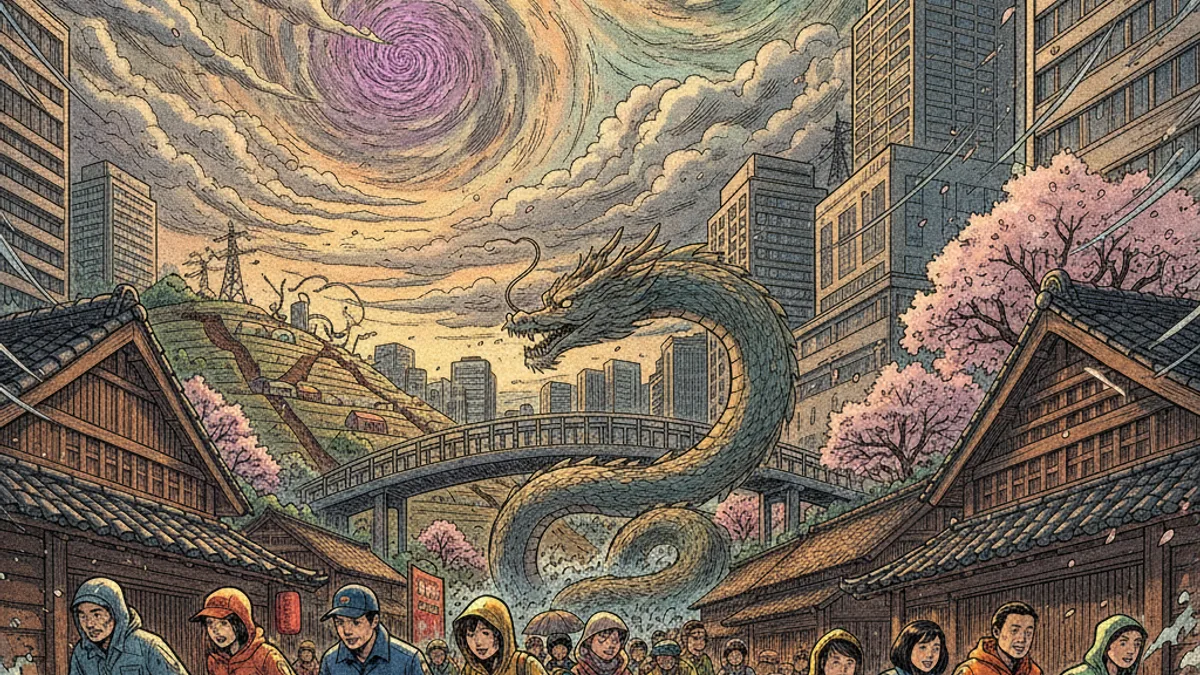
Twin Typhoons Trigger Widespread Disasters Across Japan's Eastern Regions
Typhoons 7 and 8 caused landslides, flooding, and infrastructure damage across eastern Japan on June 27th, affecting over 130,000 residents with evacuation orders and leaving ground conditions unstable.
AI-written summary of Japanese reports; not human-reviewed; check the linked sources. How we write articles
Key Points
- • Evacuation orders affected 130,000 residents in Kanagawa and entire Oshima Island population.
- • Level 4 landslide warnings issued for multiple areas despite typhoons weakening.
- • Ground remains unstable; continued landslide risk even after rain stops.
- • Agricultural reservoir breach flooded 16 homes in Fukuyama City, Hiroshima Prefecture.
Foreign residents across Japan faced significant disruption this week as Typhoons 7 and 8 brought heavy rainfall, triggering landslides, flooding, and infrastructure damage across multiple prefectures. While both storms have since weakened, authorities continue to warn of ongoing dangers from saturated ground conditions.
According to NHK, Typhoon 7 transitioned to an extratropical low-pressure system off the coast of Chiba Prefecture on the evening of June 27th at approximately 9:00 PM. However, the Japan Meteorological Agency emphasizes that residents should remain vigilant about landslide risks, particularly in eastern Japan's Pacific coastal areas where the ground remains unstable from accumulated rainfall.
The impact was particularly severe in Kanagawa Prefecture, where both typhoons made successive approaches on June 27th. As reported by Livedoor News, the cities of Yokosuka and Miura issued evacuation orders affecting approximately 130,000 residents. Landslides and cliff collapses occurred throughout Yokohama, Fujisawa, and Kamakura, highlighting the widespread nature of the damage.
Multiple areas received Level 4 emergency alerts—the second-highest warning level on Japan's five-tier disaster scale. The Yokohama Meteorological Observatory issued a Level 4 landslide warning for Miura City at 11:43 AM on June 27th, while similar alerts were issued for Tokyo's Oshima Island and Shizuoka's Shimoda City. In response, Oshima authorities ordered the island's entire population of 7,884 people across 3,947 households to evacuate at 12:30 PM.
Infrastructure damage extended beyond residential areas. In Wakayama Prefecture's Hashimoto City, a hillside collapse caused multiple solar panels to fall near a residential area, according to NHK. City officials are investigating whether the continuous rainfall that lasted through the morning of June 27th contributed to the incident, raising concerns about the stability of hillside installations during extreme weather.
One of the most serious incidents occurred in Hiroshima Prefecture, where an agricultural reservoir in Fukuyama City failed in the early hours of June 27th. The breach caused flooding in 16 downstream homes, though fortunately no injuries were reported. This incident underscores the vulnerability of aging water management infrastructure during intense rainfall events.
Transportation networks also suffered disruption. In Kochi Prefecture's Ino Town, a roadside slope collapsed late on June 26th, covering a national highway with debris. Similar damage occurred in Chiba Prefecture, where landslides blocked roads in multiple locations. Chiba's Kimitsu City issued evacuation orders at 4:41 AM for residents in designated landslide risk zones and areas vulnerable to flooding from the Koito River.
For foreign residents, understanding Japan's disaster warning system is crucial. Level 4 alerts indicate extremely high danger and require immediate action—residents in affected areas should evacuate to designated shelters or safer locations. Even after typhoons pass, saturated soil can trigger delayed landslides, particularly in mountainous or hilly areas.
Experts recommend that residents monitor local government websites and the Japan Meteorological Agency's multilingual resources for updates. Many municipalities offer disaster information through apps and emergency email systems available in English and other languages. Knowing your area's designated evacuation centers and having an emergency kit prepared remains essential, especially during typhoon season, which typically runs from May through October.
As climate patterns continue to evolve, Japan may experience more frequent intense rainfall events. Foreign residents should familiarize themselves with their neighborhood's hazard maps, available through municipal offices, which identify flood-prone areas and landslide risk zones. Taking these precautions seriously can make the difference between safety and danger during Japan's increasingly unpredictable typhoon season.
Sources
This article was written by AI from these Japanese-language reports. Check them before acting on anything here.
- [1] NHK — original report (Japanese)
- [2] Yahoo! Japan News — original report (Japanese)
- [3] NHK — original report (Japanese)
- [4] Livedoor News — original report (Japanese)
- [5] Livedoor News — original report (Japanese)
- [6] NHK — original report (Japanese)
- [7] NHK — original report (Japanese)
- [8] NHK — original report (Japanese)
- [9] NHK — original report (Japanese)
- [10] NHK — original report (Japanese)
- [11] NHK — original report (Japanese)
- [12] NHK — original report (Japanese)
- [13] NHK — original report (Japanese)