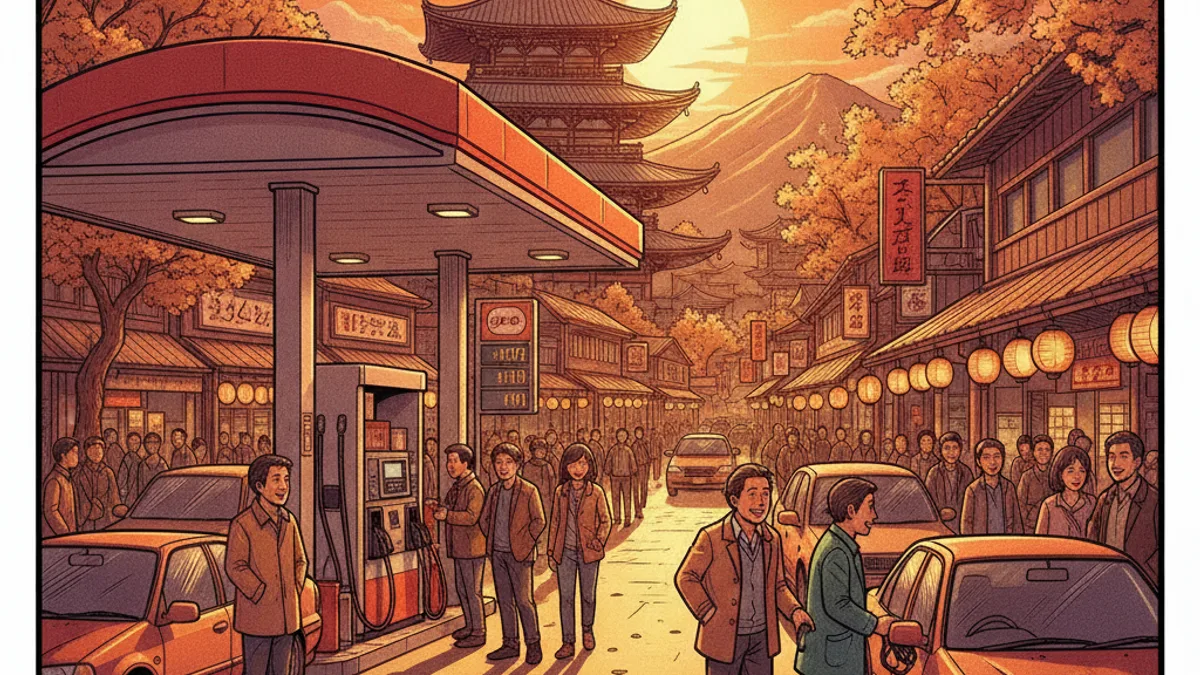
Japan Allocates 616 Billion Yen to Extend Gasoline Subsidy Program
Japan's government approved 616 billion yen to extend fuel subsidies, keeping gas prices lower amid Middle East tensions. The automatic subsidy benefits all residents at the pump without application required.
Key Points
- • Government allocated 616 billion yen to continue fuel price subsidy program.
- • Subsidy automatically applied at gas stations; no application or action required.
- • Extension responds to Middle East tensions affecting global oil prices.
- • Program duration unspecified but substantial budget suggests sustained support period.
The Japanese government has approved a massive 616 billion yen budget allocation to continue its fuel price subsidy program, providing continued relief at the pump for residents across the country, including foreign nationals living in Japan.
According to NHK, the Cabinet decided on September 1st to allocate 6,160 billion yen from this fiscal year's reserve funds to maintain the emergency price mitigation measures for gasoline and other fuels. Yahoo Japan Domestic reported the figure as 6,136 billion yen for the gasoline subsidy specifically. The program, which has been in place to cushion consumers from volatile global oil prices, will continue its support measures in response to ongoing instability in the Middle East region.
The subsidy program works behind the scenes at gas stations across Japan, with the government providing financial support to oil wholesalers and retailers to keep pump prices lower than they would otherwise be. For expats living in Japan, this means continued relief from what could be significantly higher fuel costs, particularly important for those who rely on personal vehicles for commuting or live in areas with limited public transportation options.
The decision to extend the program reflects the government's concern about the impact of international energy market volatility on Japanese households and businesses. Middle East tensions have historically driven oil price fluctuations, and the government's proactive approach aims to prevent sudden price spikes that could strain household budgets and business operations. The substantial budget allocation demonstrates the administration's commitment to economic stability during uncertain times.
For foreign residents, particularly those with families or those living outside major metropolitan areas where car ownership is more common, this subsidy continuation offers tangible financial benefits. While Japan's public transportation system is extensive in urban centers, many expats working in regional cities, suburban areas, or rural communities depend on personal vehicles for daily transportation needs. The subsidy helps maintain predictable fuel costs, making it easier to budget monthly expenses.
The program's extension also has broader implications for the Japanese economy. Stable fuel prices help control inflation and support various industries that depend on transportation, from logistics companies to small businesses. For expats working in these sectors or running their own businesses in Japan, predictable fuel costs contribute to more stable operational expenses.
It's worth noting that this subsidy is applied automatically at the point of sale, meaning residents don't need to apply for it or take any special action to benefit. When you fill up at any gas station in Japan, the subsidized price is what you pay at the pump. This seamless implementation ensures that all residents, regardless of nationality or language ability, benefit equally from the program.
The government's use of reserve funds to finance this extension indicates the measure's emergency nature and the administration's flexibility in responding to economic pressures. While the exact duration of the extended program hasn't been specified in the announcements, the substantial budget allocation suggests the government is preparing for a sustained period of support.
For expats planning their finances in Japan, the continuation of this subsidy program provides some certainty in an area of household expenses that can otherwise be unpredictable. However, it's advisable to remain aware that such subsidy programs are temporary measures, and future fuel costs may increase once government support is eventually phased out. The program's continuation demonstrates Japan's commitment to supporting residents through economic challenges, but long-term financial planning should account for potential changes in fuel prices once subsidies end.
Sources
This article was written by AI from these Japanese-language reports. Check them before acting on anything here.
- [1] Yahoo! Japan News — original report (Japanese)
- [2] NHK — original report (Japanese)
AI-written summary of Japanese reports; not human-reviewed; check the linked sources. How we write articles