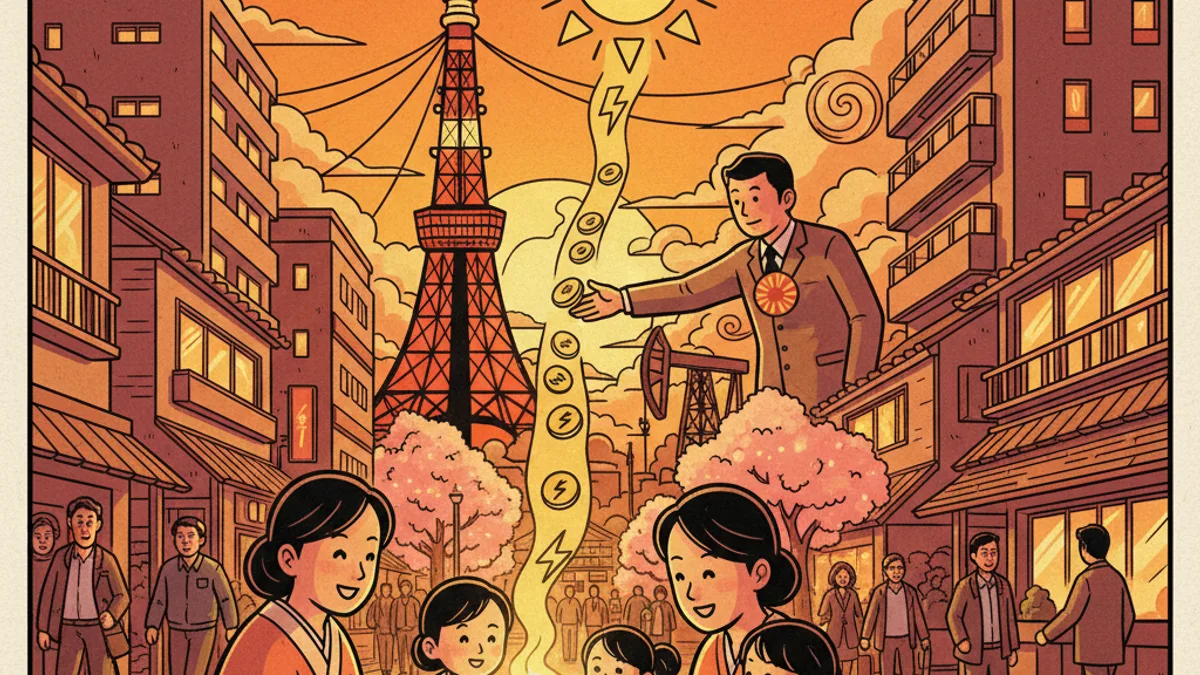
Japan Eyes Supplementary Budget for Energy Support Amid Middle East Crisis
Japan's government is considering a supplementary budget to subsidize electricity and gas bills if Middle East tensions cause prolonged energy price increases, with an announcement possible next week.
Key Points
- • Government may announce supplementary budget decision next week per Yahoo Japan.
- • Energy subsidies would likely apply automatically to all utility customers nationwide.
- • Middle East tensions could significantly increase electricity and gas costs for households.
- • No special applications typically required; subsidies appear as automatic bill discounts.
The Japanese government is considering implementing a supplementary budget to provide energy subsidies for households and businesses as Middle East tensions threaten to drive up electricity and gas prices, according to reports from NHK.
Prime Minister Takaichi held discussions with senior Liberal Democratic Party officials, including Vice President Aso and Secretary-General Suzuki, to exchange views on measures to address potential long-term impacts from the Middle East situation and the necessity of compiling a supplementary budget for the current fiscal year, NHK reported on May 15.
The discussions come as concerns mount both within the ruling coalition and among opposition parties about the potential economic fallout if Middle East instability persists. Voices from across the political spectrum are calling for government intervention to cushion the impact on energy costs through subsidies for electricity and gas bills.
For foreign residents in Japan, these developments could have significant implications for household budgets. Japan imports the vast majority of its energy resources, making it particularly vulnerable to disruptions in global energy markets. The Middle East remains a critical source of oil and natural gas for the country, and any prolonged crisis in the region typically translates to higher energy costs for consumers.
The government's consideration of a supplementary budget suggests officials are preparing for a scenario where energy prices rise substantially and remain elevated for an extended period. Such subsidies, if implemented, would likely follow the pattern of previous support measures that provided direct reductions on utility bills for both residential and commercial users.
During previous energy crises, the Japanese government has implemented subsidy programs that appeared as automatic discounts on monthly electricity and gas bills, requiring no special application from consumers. If similar measures are adopted this time, foreign residents would benefit automatically, regardless of visa status or nationality, as long as they maintain active utility accounts.
The timing of any potential supplementary budget announcement remains unclear, though Yahoo Japan reported that Prime Minister Takaichi may make a formal statement next week. The government appears to be carefully monitoring the Middle East situation while consulting with ruling party leadership to determine the appropriate scale and scope of intervention.
For expats, several factors make this development particularly relevant. First, energy costs in Japan already represent a significant portion of monthly household expenses, especially during summer and winter months when air conditioning and heating usage peaks. Any increase in baseline energy prices could substantially impact family budgets.
Second, unlike some countries where energy markets are more liberalized and competitive, Japan's utility sector remains relatively concentrated, meaning price increases from suppliers tend to affect consumers directly and uniformly. Government subsidies have historically been one of the few mechanisms available to provide rapid relief to households facing energy cost spikes.
Third, foreign residents should be aware that such support measures, when implemented, typically apply universally to all utility customers within Japan. There are generally no citizenship requirements or special registration procedures needed to benefit from energy subsidies.
The government's proactive consideration of a supplementary budget reflects lessons learned from previous energy shocks, including those following the 2011 Fukushima disaster and the 2022 global energy crisis triggered by the Ukraine conflict. In both instances, delayed government response led to significant public criticism and economic hardship for households.
As the situation develops, foreign residents should monitor official government announcements and communications from their utility providers. Any implemented subsidies would likely be announced through multiple channels, including utility company websites, which increasingly offer information in English and other languages.
While the exact details of any support package remain under discussion, the government's active consideration of intervention suggests officials recognize the potential severity of energy cost increases and are preparing to act if necessary to protect household finances across Japan.