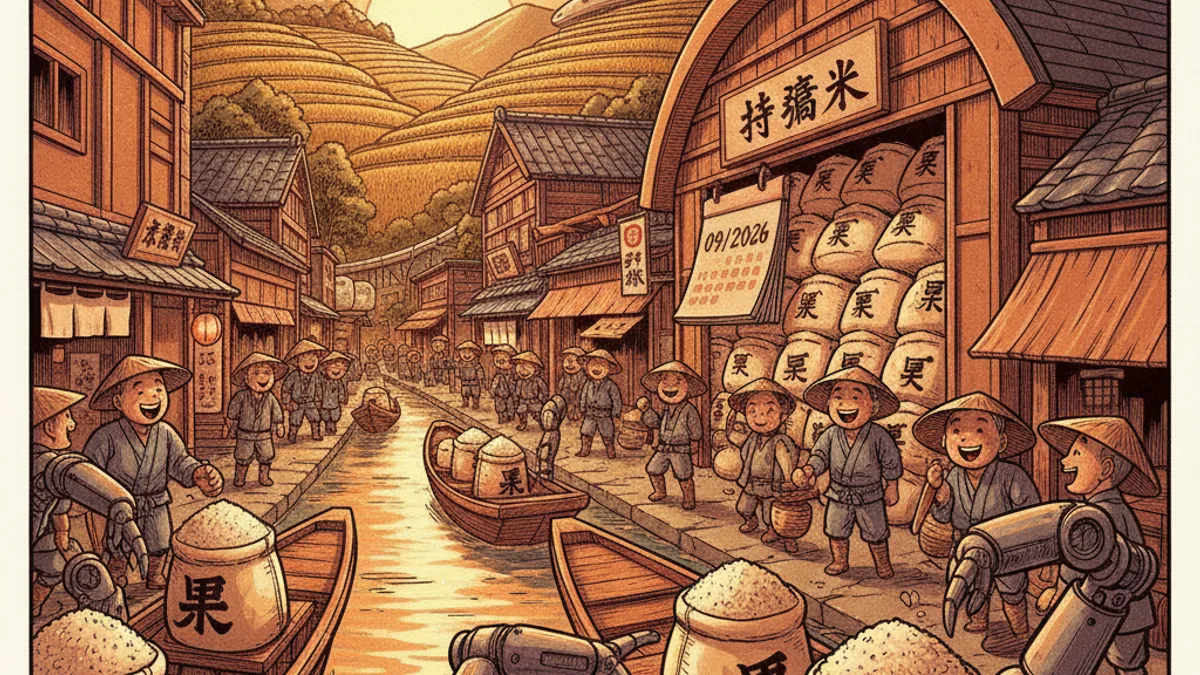
Japan to Replenish Rice Reserves in September Amid Supply Management
Japan's agriculture ministry will buy back 150,000 tons of reserve rice in September 2026, focusing on 2025-harvest rice currently held in private inventories to rebuild strategic reserves.
Key Points
- • Ministry purchasing 150,000 tons of reserve rice during September 2026.
- • Buyback focuses on 2025-harvest rice accumulated in private sector inventories.
- • No immediate impact expected on supermarket rice availability or prices.
- • Final quantities depend on monitoring 2026 harvest conditions across Japan.
Japan's Ministry of Agriculture, Forestry and Fisheries (MAFF) is finalizing plans to buy back government reserve rice in September 2026, according to reports from NHK. This move comes as the ministry seeks to manage rice supply levels following last year's release of stockpiled rice into the market.
The decision represents a significant shift in Japan's rice supply management strategy and reflects the government's ongoing efforts to balance market stability with adequate emergency reserves. For foreign residents in Japan, understanding these policy moves provides insight into potential rice price fluctuations and availability in the coming months.
According to NHK, the ministry plans to repurchase approximately 150,000 tons of reserve rice that was released to the market last year. The buyback will focus primarily on 2025-harvest rice, which has accumulated in private sector inventories. MAFF is currently conducting final adjustments to determine the exact quantity to be repurchased, taking into account the condition and availability of newly harvested rice from various regions across Japan.
Japan maintains strategic rice reserves as part of its food security policy, typically holding enough stockpiled rice to cover potential shortages caused by poor harvests or natural disasters. When the government released these reserves in 2025, it was likely responding to supply concerns or price pressures at that time. Now, with private inventories reportedly well-stocked, the ministry has determined it's an appropriate time to rebuild government reserves.
The timing of the September buyback is strategically significant. This period coincides with the early stages of Japan's rice harvest season, which typically runs from August through October depending on the region. By monitoring the progress of the 2026 harvest, MAFF can better assess how much rice needs to be purchased to maintain adequate reserves without disrupting market prices or creating artificial shortages.
For expats living in Japan, this policy decision is unlikely to cause immediate disruptions to rice availability in supermarkets or changes in retail prices. However, it does signal that the government is actively managing rice supply levels, which could have subtle effects on pricing in the medium term. The buyback of 150,000 tons represents a substantial quantity—enough to fill the rice needs of millions of households—but Japan's overall rice market is large enough to absorb this government activity without dramatic impact on consumers.
The announcement also reflects Japan's broader agricultural policy challenges. The country has long struggled to balance protecting domestic rice farmers through various support mechanisms while managing consumer prices and maintaining food security. Government rice reserves serve multiple purposes: they provide a buffer against crop failures, help stabilize prices during shortages, and support farmers by purchasing surplus production when necessary.
Foreign residents should note that Japan's rice market operates differently from many other countries, with significant government involvement in pricing and distribution. Understanding these mechanisms can help expats better anticipate potential changes in food costs and availability.
As the September buyback approaches, MAFF will continue monitoring the 2026 harvest conditions across Japan's major rice-producing regions, including Niigata, Akita, and Hokkaido. The final decision on purchase quantities will depend on these assessments, ensuring that the government's actions support rather than disrupt market stability.
For now, consumers can expect rice supplies to remain stable, with the government's reserve management activities operating behind the scenes to maintain Japan's food security infrastructure. This buyback represents routine management of strategic reserves rather than a response to any immediate crisis, providing reassurance about the stability of Japan's rice supply system.
Sources
This article was written by AI from these Japanese-language reports. Check them before acting on anything here.
- [1] NHK — original report (Japanese)
- [2] Livedoor News — original report (Japanese)
- [3] Yahoo! Japan News — original report (Japanese)
AI-written summary of Japanese reports; not human-reviewed; check the linked sources. How we write articles