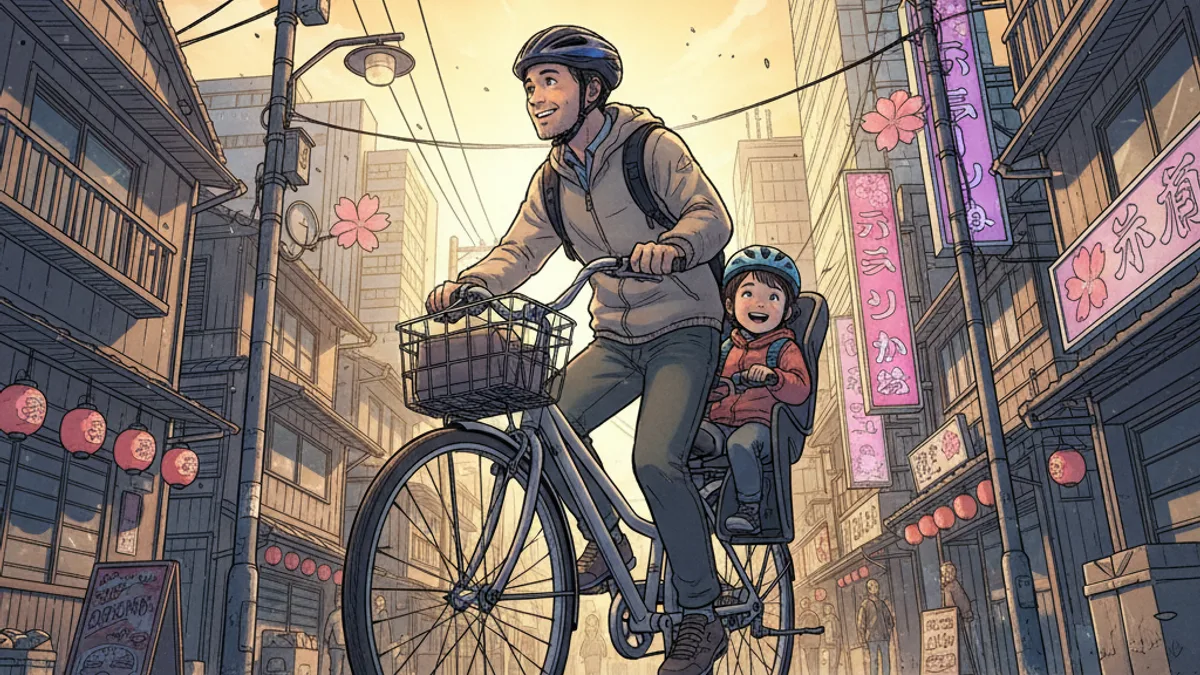
Japan to Review Age Limits for Children on Bicycle Seats
Japan's National Public Safety Commission announced it will review current age and size limits for children riding in bicycle seats, potentially expanding regulations that currently restrict use to children under six.
Key Points
- • Government reviewing bicycle child seat age limits announced May 14, 2026.
- • Current rules limit bicycle seats to children under six years old.
- • Existing regulations remain in effect during the review period.
- • No timeline announced for review completion or potential rule changes.
Japan's National Public Safety Commission is considering expanding the current regulations governing which children can ride in bicycle seats, a move that could affect many foreign families living in the country. The announcement, made by National Public Safety Commission Chairman Akama on May 14, 2026, signals a potential shift in bicycle safety policies that have remained largely unchanged for years.
According to NHK, Chairman Akama revealed during a press conference that the government will examine whether the current age and size restrictions for children riding in bicycle-mounted child seats can be expanded. This review comes as part of broader discussions about family transportation needs in urban Japan, where bicycles remain a primary mode of transport for parents with young children.
Currently, Japanese traffic regulations limit the use of bicycle child seats to children under six years old. These rules are enforced through prefectural road traffic ordinances, which specify both age limits and weight restrictions for front and rear-mounted seats. Front seats typically accommodate children up to age two or around 15 kilograms, while rear seats are designed for children up to age six or approximately 22 kilograms.
For expat families in Japan, bicycles often serve as essential transportation, particularly in cities where parking is expensive and public transit, while extensive, can be challenging with small children. Many foreign residents rely on "mamachari" – the ubiquitous utility bicycles equipped with child seats – for daily errands, daycare drop-offs, and school runs. The current age restrictions can pose challenges for families with larger children or those whose children exceed the weight limits before reaching the maximum age.
The government's review will examine whether these restrictions can be safely modified to accommodate a wider range of children. This could potentially include raising age limits, adjusting weight restrictions, or introducing new categories of approved child seats designed for older or larger children. However, any changes would need to balance practical family needs with safety considerations, as bicycle accidents involving children remain a concern for traffic safety authorities.
Yahoo Japan's coverage of the announcement highlights that this review represents a significant policy consideration, though no specific timeline for the review process or potential implementation of changes has been announced. The National Public Safety Commission will likely consult with traffic safety experts, bicycle manufacturers, and prefectural authorities as part of its evaluation process.
For foreign residents, it's important to note that current regulations remain in effect while this review is underway. Parents must continue to follow existing rules regarding child bicycle seats, including age and weight limits, as well as requirements that children wear helmets. Violating these regulations can result in fines and points on a driver's license if the cyclist holds one.
The review also reflects broader demographic and social changes in Japan. With an aging population and declining birth rates, the government has increasingly focused on policies supporting families with children. Expanding bicycle seat regulations could make daily life more convenient for parents, potentially supporting work-life balance initiatives that are part of Japan's efforts to create more family-friendly environments.
Expat families should monitor announcements from the National Public Safety Commission and their local prefectural governments for updates on this policy review. Any changes to bicycle child seat regulations would likely be announced well in advance of implementation, giving families time to adjust their transportation arrangements or purchase new equipment if needed.
While the outcome of this review remains uncertain, the government's willingness to reconsider these long-standing regulations demonstrates responsiveness to the practical needs of families using bicycles as primary transportation. Foreign residents who depend on bicycles for family transportation will want to stay informed as this policy discussion progresses throughout 2026.