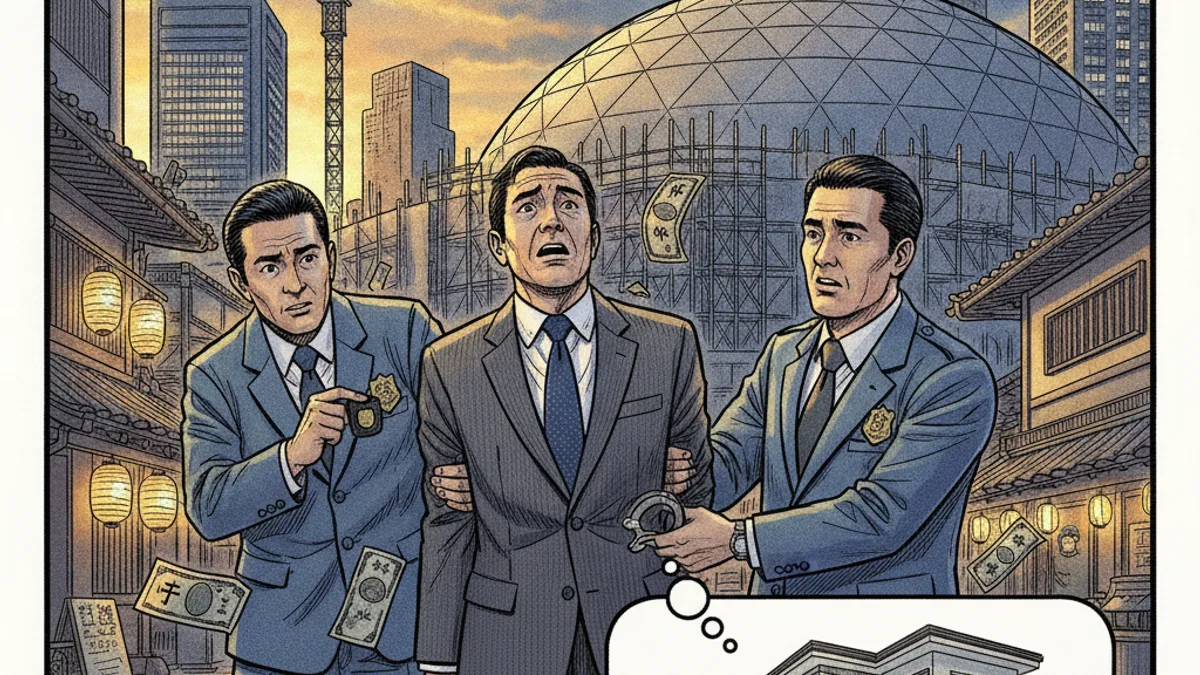
Osaka Expo Construction Scandal: Takenaka Employee Arrested for Fraud
Takenaka Corporation employee arrested for allegedly embezzling 13 million yen through inflated Expo construction bills to fund personal home renovations, highlighting accountability issues in major public projects.
Key Points
- • Takenaka employee arrested for 13 million yen fraud on Expo construction project.
- • Suspect allegedly used subcontractors to renovate personal home through inflated billing.
- • Breach of trust charges in Japan carry severe penalties including imprisonment.
- • Incident highlights importance of strict financial compliance on Japanese public projects.
A senior employee of Takenaka Corporation, one of Japan's largest construction firms, has been arrested on suspicion of embezzling over 13 million yen through fraudulent billing schemes related to the 2025 Osaka-Kansai Expo construction project. The arrest, reported by NHK on August 19, 2026, has raised serious questions about oversight and accountability in one of Japan's most high-profile international events.
According to NHK, the arrested employee served as the on-site supervisor for Takenaka Corporation's work at the Expo venue. Authorities allege that he inflated construction costs and used subcontractors to renovate his personal residence, causing approximately 13 million yen in damages to his employer. The charges fall under breach of trust (背任, hainin), a serious white-collar crime in Japan that involves abusing one's position for personal gain at the expense of their employer or clients.
The scheme reportedly involved manipulating invoices and billing records for work ostensibly related to the Expo construction project. By routing payments through subcontractors, the suspect allegedly arranged for renovations to his own home while disguising these expenses as legitimate Expo-related costs. This type of fraud not only damages the construction company but also potentially inflates the overall costs of public projects funded by taxpayer money.
Takenaka Corporation, founded in 1610 and one of Japan's most prestigious construction companies, released a statement following the arrest, according to Yahoo Japan Business. While the specific contents of the company's response were not detailed in available reports, such statements typically express apologies and commitments to cooperate with investigations. The incident represents a significant reputational challenge for a company that has built landmarks across Japan and maintains a reputation for quality and reliability.
For foreign residents in Japan, this scandal highlights several important aspects of Japanese business culture and legal accountability. White-collar crime, particularly involving public projects, is taken extremely seriously in Japan. The breach of trust charge carries potential penalties including imprisonment and substantial fines. Japanese prosecutors maintain a conviction rate exceeding 99 percent, meaning arrests in such cases typically result in prosecution and conviction.
The Osaka-Kansai Expo, originally scheduled for 2025, has been plagued by various challenges including cost overruns, construction delays, and now this corruption scandal. The event was intended to showcase Japan's innovation and cultural heritage to the world, with the theme "Designing Future Society for Our Lives." However, mounting costs and controversies have generated public criticism about whether the massive investment serves taxpayers' interests.
This case also reflects broader concerns about construction industry practices in Japan. The complex subcontracting system, while standard in Japanese construction, can sometimes create opportunities for financial irregularities when oversight is inadequate. Multiple layers of subcontractors can obscure the actual flow of money and make fraudulent schemes more difficult to detect.
For expats working in construction, project management, or related fields in Japan, this incident serves as a reminder of the importance of strict compliance with financial controls and reporting requirements. Japanese companies and authorities maintain rigorous standards for documentation and accountability, particularly on public projects. Foreign professionals should ensure they understand their companies' compliance procedures and reporting obligations.
The investigation continues, and additional details may emerge about the extent of the alleged fraud and whether other individuals were involved. The case will likely prompt Takenaka Corporation and other major contractors to review their internal controls and oversight mechanisms for large-scale projects. As Japan continues to host major international events and undertake significant infrastructure projects, maintaining public trust through transparency and accountability remains essential.
Sources
This article was written by AI from these Japanese-language reports. Check them before acting on anything here.
- [1] NHK — original report (Japanese)
- [2] Yahoo! Japan News — original report (Japanese)
- [3] Yahoo! Japan News — original report (Japanese)
AI-written summary of Japanese reports; not human-reviewed; check the linked sources. How we write articles